
Hockey stick trainer
A hockey stick trainer is a weighted base that clamps onto old or broken hockey sticks and stands them upright on the ice, turning a spare stick into a stationary defender. Players use it to practise stickhandling through a real stick blade, shooting around a defender’s reach, and skating tight turns against something that occupies space the way an opponent does — instead of a cone, which a puck rolls straight over. It adds an opponent to a solo practice without needing a second player, and it works on ice, in a driveway, or on a shooting pad.
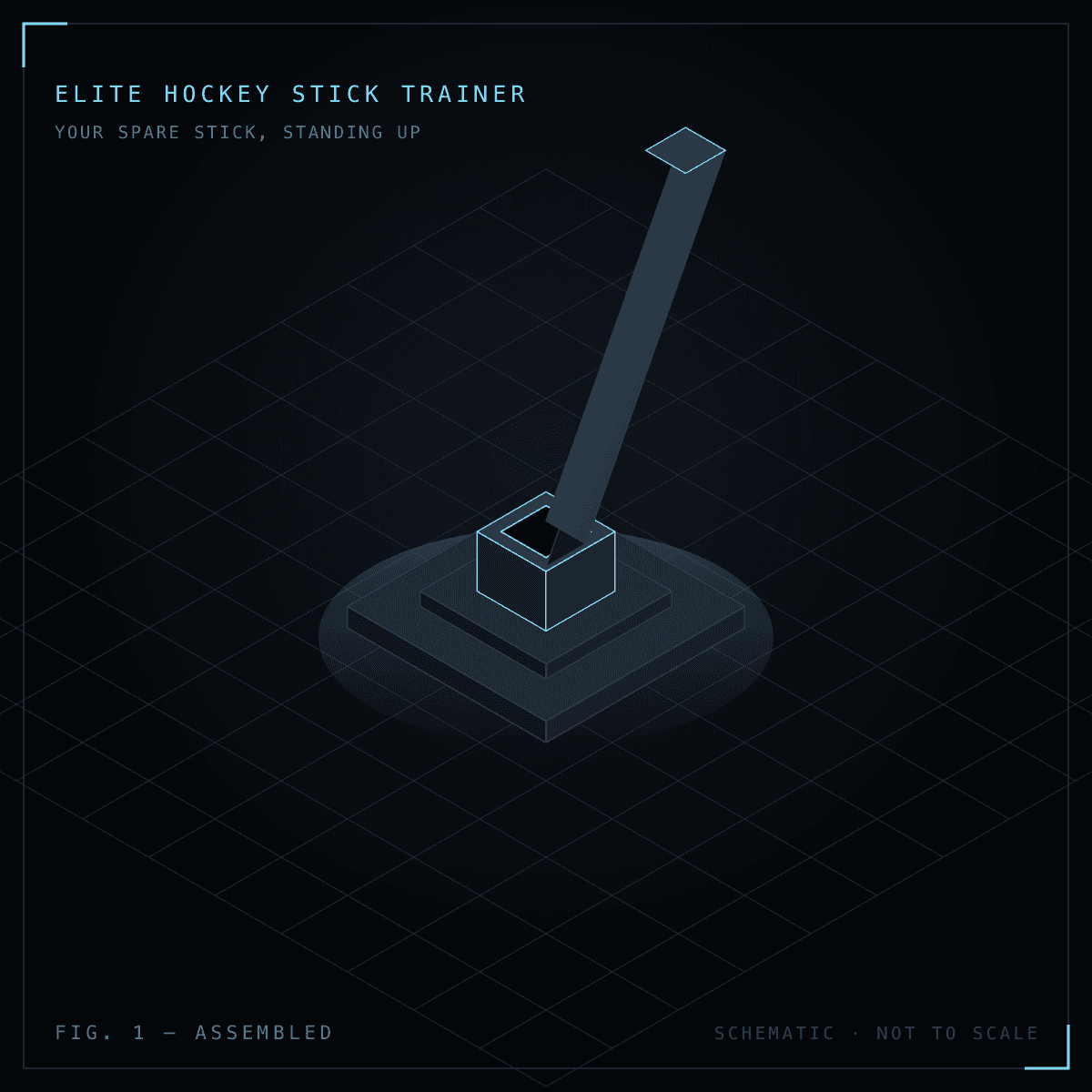
Elite Hockey Stick Trainer
Turns any spare or broken stick into a stationary defender for on-ice and off-ice reps.
- Mounts broken or unused sticks — the shaft you already own is the training aid
- Adjustable stick angle, so the same base is a poke check, a screen or a gate
- Open frame: shoot through it as well as around it
- Works on ice, on a shooting pad, in a driveway or on a garage floor
Ships from Bellefonte, PA in 1–2 business days · 30-day free returns
View productA real stick in the lane, at real height.
A cone teaches the wrong habit
Cones sit six inches off the ice and a puck slides over them. A player weaving cones learns to move the puck laterally in open space — a skill they already have. What they do not get is a blade in the lane, which is the thing that actually forces a deke, a toe drag, or a shot placed around an obstruction. A stick trainer puts a real stick in the lane at real height, so the reps rehearse the decision the game asks for.
It occupies space, so shots have to be placed
Standing a stick up in front of the net creates a screen and a shooting lane that is genuinely narrower on one side. That turns "shoot at the net" into "shoot past something", which is the difference between a rep that builds power and a rep that builds accuracy. Set two of them at the blue line and a player has to pick a side before they arrive — the read, not just the release.
It gives an old stick a second life
Every hockey family has broken or outgrown sticks in the garage. A trainer base is designed around that: the stick you already own becomes the training aid, so the cost per obstacle is the base, not a new moulded defender. That is also why it packs down — the bulky part is the stick you were storing anyway.
It travels between surfaces
The same base works on ice, on a synthetic shooting pad, in a driveway, or on a garage floor. A player doing off-ice stickhandling in December is rehearsing against the same obstacle geometry they will see at the rink, which is the whole point of off-ice work.
Four things to check.
There are only four things that separate one stick trainer from another, and price is not the first of them.
Does it hold a stick that is actually broken?
The whole economic argument for this category is that you already own the expensive part. A base that only grips an intact shaft with the knob removed is a base that cannot use the sticks in your garage. Check that the mount takes a snapped shaft with the knob still taped on.
Does it stay put when a puck hits it?
Weight is the honest spec here. A trainer that slides on contact turns every rep into a reset. Steel bases in this category run in the 500–800 gram range; anything much lighter is a cone with extra steps.
Can a puck pass through it?
An open frame lets you shoot through the trainer as well as around it, which adds a second set of drills. A solid moulded body only gives you the “around” half.
How adjustable is the stick angle?
Fixed-angle bases give you one obstacle geometry. Adjustable ones let the same trainer be a defender's poke check at one angle and a screen at another, which is what keeps the drills from going stale.
Once those four are equal, price is the whole comparison. See the side-by-side against the GC Transformer Pylon.
Stick trainers, answered.
What is a hockey stick trainer?
It is a weighted base that grips a hockey stick and holds it upright on the ice or on a shooting pad, turning a spare stick into a stationary defender for stickhandling, shooting and skating drills.
Does it work with any hockey stick?
It is designed for standard senior, intermediate and junior shafts, including broken sticks — the shaft is what mounts into the base, so a snapped stick with an intact shaft is ideal.
Can I use it on the ice and off the ice?
Yes. The same base works on ice, on a synthetic shooting pad, on a driveway, and on a garage floor, so the same drill geometry carries between on-ice and off-ice sessions.
Will pucks damage it?
It is built to be shot at. Pucks pass around or through the frame rather than into a moulded surface.
What age or level is it for?
Anyone from a youth player working on head-up puck handling through to junior and adult players doing off-season shooting volume. The drill difficulty comes from how you set it up and how fast you go, not from the equipment.
How is it cheaper than the alternatives?
We sell it directly from our own shop rather than through a distributor and a retailer. Shipping is quoted live from the carrier at checkout instead of being padded into a flat fee.